
Don’t Drag your Feet
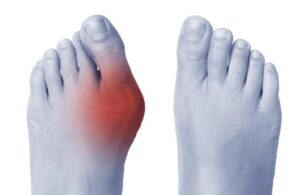
When to see a doctor for bunions and what you should know about the Lapidus procedure, also known as the 3D bunion correction®.
At BCOS, we are lucky to have Dr. Andrew Peacock, an exceptional foot and ankle specialist, along with our new associate, Dr. Alex Sheltzer, on staff. While they treat a variety of orthopedic foot and ankle issues from chronic ailments to traumatic injuries, here we are focused on bunions, a painful condition for many patients. Check out Dr. Peacock’s answers below to a few questions about bunions, the Lapidus procedure that many patients ask about, and when you should see a doctor for bunions.
What is a bunion?
Dr. Andrew Peacock: A bunion is a complex, three-dimensional deformity of the foot that appears as a bump at the base of the big toe. Bunions can develop over several years and can be caused by a variety of factors that put extra pressure on the big toe, leading it to be pushed out of alignment. Bunions can range from mild to severe, but they are often uncomfortable for patients, and can be aggravated by even everyday activities.
The Lapidus procedure for bunions is getting a lot of attention in the media. What is a Lapidus procedure?
Dr. Andrew Peacock: The Lapidus procedure can be used to treat bunions of varying severity. It is named after Dr. Paul Lapidus, who is often considered the father of modern foot and ankle surgery. So, the procedure itself has been around for about 70 years. It is used to correct the alignment of the entire bone, in all three planes, rather than just one or two, which had been the traditional approach. We do the Lapidus procedure very often and with great results, as it repairs the unstable foundation and restores proper mobility for patients.
What is Lapiplasty®?
Dr. Andrew Peacock: Lapiplasty® is just a brand name for the Lapidus procedure. Many patients have heard of it through promotional material and marketing, but it is similar to the Lapidus procedure we are doing, which is also known as 3D bunion correction® or 4D bunion correction. Regardless of the name, the Lapidus procedure means correction of all three planes of the bunion.
When should you see a doctor if you have a bunion?
Dr. Andrew Peacock: If you have a bunion, it is best to get an evaluation from a physician sooner rather than later. Bunions will not go away on their own, they are a progressive condition that can lead to other problems such as hammer toes, arthritis, and bone spurs.
But the most important thing I want patients to know is that as orthopedic specialists, we offer options like the Lapidus procedure or 3D bunion correction®, but our thorough evaluation often results in the possibility of a less invasive option with a faster recovery time. Some patients come in thinking they need a major surgery like the Lapidus procedure, but after evaluation, we find they only need a minor procedure, like spur removal.