

Everything You Need to Know About Ankle Sprains

With school sports in full swing, we see a predictable rise in ankle injuries. “In sports like football, soccer, basketball, tennis, and field hockey players are running, rolling, sliding, jumping, and required to make fast lateral movements. Spraining an ankle is unfortunately all too common,” says Dr. Andrew Peacock, a foot and ankle specialist at Bucks County Orthopedic Specialists (BCOS). In fact, sprained ankles are the #1 reason for missed participation in athletics, according to the American Academy of Orthopedic Surgeons.
Of course, not all sprained ankles are equal. Some will keep you off the field for days, others for weeks, or even months.
Here we tackle some of the common issues and frequently asked questions about ankle sprains.
(If you or your loved one has suffered an ankle injury, contact us at 215-348-7000 to make an appointment at one of our three office locations.)
What happens when you “twist your ankle”?
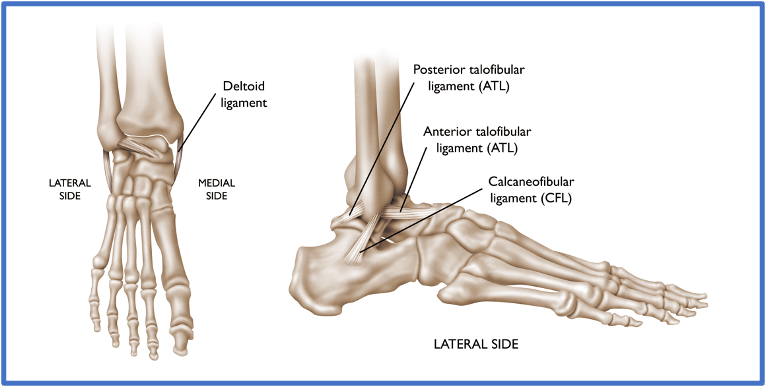
“What we commonly call a “twisted ankle” happens when the foot rolls too far inward, or inverts. As the foot rolls, twists, or turns beyond it’s normal range of motion, it can cause over-stretching or tearing of the strong ligaments that work together to stabilize the ankle,” says Dr. Peacock.
There are three main ligaments in this area of the ankle, the anterior talofibular (ATFL), the calcaneofibular (CFL), and posterior talofibular (PTFL). When an ankle twists, the anterior talofibular and calcaneofibular ligaments are the most commonly injured ligaments.
What is an ankle sprain?
When ligaments in and around the ankle are overstretched or torn, that is typically called a sprained ankle. There are varying degrees and types of ankle sprains, ranging from tiny microtears of the fibers to complete tears of one or more ligaments.
What are the symptoms of a sprained ankle?
The severity of symptoms varies greatly depending on the degree of the injury. However, common symptoms of a sprained ankle include:
- Pain (with weightbearing, activity, and/or at rest)
- Swelling
- Tenderness to the touch
- Bruising
- Instability of the joint
- Inability to move the foot/ankle through a normal range of motion
Do I need an x-ray for a sprained ankle?
“Ligaments attach bones to other bones. So, with a serious ankle sprain, it’s possible that the force on the ligament was so strong a piece of bone breaks off. This is known as an avulsion fracture, and can be fairly common with ankle sprains,” says Dr. Peacock.
So, if you twisted your ankle or suspect you have a significant ankle sprain, it is highly recommended to see a healthcare professional who can do a proper evaluation and order x-rays if necessary.
How is a sprained ankle diagnosed?
“In our office, we will perform a thorough physical exam of the foot and ankle, take x-rays to rule out a fracture, and order an MRI if warranted,” says Dr. Peacock. “It’s important for us to be able to see the patient, learn about the circumstances of the injury, observe the swelling, check for tenderness, test for range of motion and stability, and judge the patient’s ability to bear weight on the joint. The combination of physical exam and imaging studies allows us to make an accurate diagnosis, which is so critical for creating a treatment plan that can get our patients back on the field, or back to daily activities as quickly and safely as possible.”
How can I tell how severe my ankle sprain is?
There are three grades of ankle sprains, determined by how much damage has occurred to the ligaments around the ankle. Here are the grades, as defined by the American Academy of Orthopedic Surgeons:
Grade 1
- Slight stretching and microscopic tearing of the ligament fibers
- Mild tenderness, bruising, and swelling around the ankle
- Typically, no pain with weightbearing
- No instability on examination
Grade 2
- Partial tearing of the ligament
- Moderate tenderness, bruising, and swelling around the ankle
- Mild pain with weightbearing
- Slight instability on examination
Grade 3
- Complete tear of the ligament
- Significant tenderness, bruising, and swelling around the ankle
- Severe pain with weightbearing
- Substantial instability on examination
How do you treat a sprained ankle at home?
The acronym R.I.C.E. is very useful for most sprained ankles.
Rest. Stay off the affected ankle as much as possible, avoid activities that irritate the joint or cause pain or discomfort.
Ice. As soon as possible, apply ice to the ankle to reduce swelling. Continue using ice, in 15-minute intervals, several times a day for a few days following an ankle sprain.
*Insider Tip: Adding salt to your ice bag can help it stay colder longer and discourage the ice from sticking together.
Compression. Wrap the ankle in an elastic bandage to provide support and reduce swelling.
Elevate. Sit or lie in a position that allows you to elevate the ankle above the heart to reduce swelling.
You can also take over-the-counter medications to manage symptoms. Medications like acetaminophen (Tylenol) can be effective for pain management, while ibuprofen (Advil, Motrin), and naproxen sodium (Aleve) can address swelling as well as pain.
What is an ice bath? Will an ice bath help my sprained ankle?
An ice bath (also known as a slush bath) refers to immersing the affected body part in icy water for a short period of time. Ice baths can be very effective for reducing pain and swelling associated with an ankle sprain.
How can I do an ice bath for my sprained ankle?
Fill a large bucket with crushed ice and water (you can also add some salt to the mixture). Place your entire foot and ankle in the ice-water-filled bucket and leave it there for 10-15 minutes, but no longer than that. It can be difficult at first, but your foot will quickly become numb to the cold and having the entire joint surrounded by ice is beneficial for reducing inflammation.
Should I get physical therapy for a sprained ankle?
“Physical therapy can certainly help the recovery process from a sprained ankle, and I frequently prescribe it,” says Dr. Peacock. “As sports medicine specialists, we see so many patients who want to get back on the field or in the game as quickly as possible. Not only does a physical therapist provide treatments and exercises to restore range of motion, but they also guide patients through exercises to strengthen the ankle joint that can be weakened by the sprain. So physical therapy can aid recovery and help reduce the chance of reoccurrence.”
How long does it take to recover from a sprained ankle?
The length of recovery from a sprained ankle varies greatly depending on the severity of the injury. A mild ankle sprain can feel better in a matter of days or a couple of weeks with minimal treatment. A more severe sprain can take weeks or even months to heal and may require crutches and bracing. Physical therapy can aid in the recovery process by restoring movement and strength to the ankle joint through treatments and guided exercises. After a thorough evaluation, your doctor will be able to provide a possible timeline for recovery.
Ankle sprains are painful…and common. If you or your loved one has twisted their ankle and it is painful, swollen, or unstable – contact us as soon as possible at 215-348-7000 and schedule an appointment at one of our office locations in Doylestown, Warrington, or Newtown/Langhorne.
More BCOS Resources for Ankle Issues: