
Want to know what orthopedic doctors do when they’re running a marathon? Check out these tips from a trio of our marathon running docs.

26.2 miles. It seems like a long way to drive, let alone run. And yet, thousands of people of all sizes, shapes, and backgrounds line up at starting lines all around the world to complete this ultimate test of stamina. In fact, about 1.1 million runners complete a marathon each year, according to the International Institute for Race Medicine.
As you can imagine, orthopedic doctors encounter many of these ambitious athletes who are pushing their bodies to the brink. So, we figured who better to ask for marathon advice than an orthopedic doctor? Well, how about an orthopedic doc who is also a marathon runner?
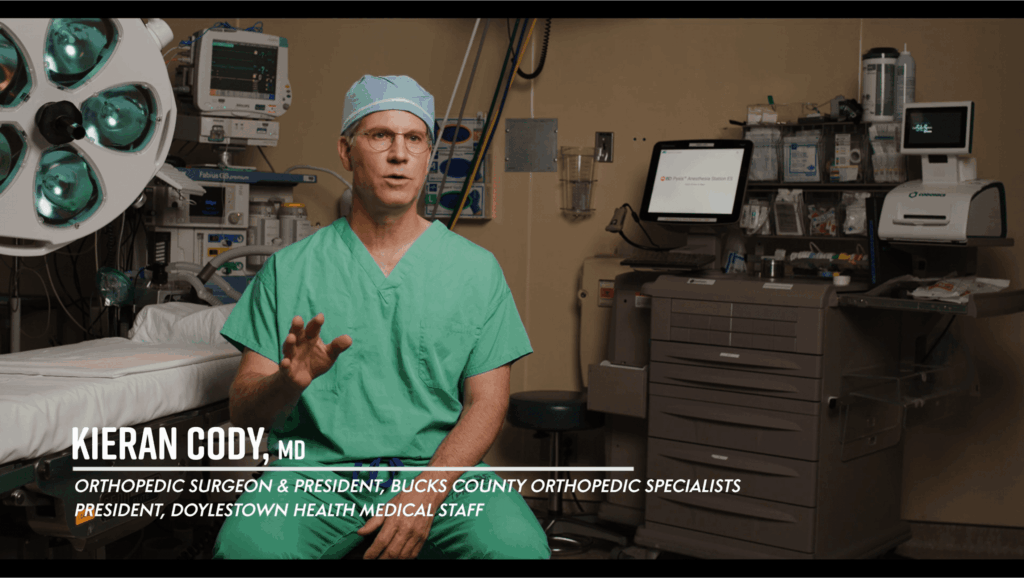
Here we’ve compiled some training and race-day tips from three of our marathon-running orthopedic specialists, Dr. Kieran Cody, Dr. Sue Griffith, and Dr. Thomas Vikoren.
(If chronic or urgent orthopedic problems are impeding your training program, contact us and schedule an appointment with one of our sports medicine specialists.)

Follow a training plan.
Marathons are very rewarding, but they take a tremendous amount of planning and training in order to do your best and not get injured. The key is starting months in advance with gradually increased training. There are many excellent marathon training programs available online, the key is to be consistent and stick with the plan. – Dr. Kieran Cody, an orthopedic surgeon who specializes in knee and shoulder issues, and recently became the first surgeon at Doylestown Hospital to perform minimally invasive balloon shoulder arthroplasty surgery for massive rotator cuff tears.
The shoe fits.
Make sure that your training and race shoes have no more than 300 miles on them. Keep track of your mileage. And, have a running store help you with the fitting of your shoes initially. Some people have high arches, some have flat feet or almost no arch, some people over-pronate, while others are pigeon-toed. All of these variations call for a different type of running shoe – a good running store will help you make sure you are wearing the right shoe for your foot and gait. – Dr. Sue Griffith, a sports medicine doctor and pediatric orthopedic specialist who’s completed 13 marathons.
Run the distance.
Do not skip weekly long runs that are a part of all marathon training programs. However, you can occasionally give yourself grace on the shorter runs if you are sick or physically not up to it. – Dr. Sue Griffith
Fuel for the road.
Get a running belt or camel pack for your energy gels, hydration, and cellphone for your long runs. – Dr. Sue Griffith
Safety first.
Wear reflective gear and bright clothing, so you are easily seen by drivers and cyclists. Have your ID and an emergency contact info on you in case you have health issues during training or on race day. – Dr. Sue Griffith
Schedule rest.
This might seem somewhat counterintuitive but allow your body to rest the week or two before the marathon and don’t continue to train right up to race day. The resting will actually increase your body’s preparedness for the race, and you will perform much better. Trust your training. – Dr. Kieran Cody
Pace yourself.
When running a marathon, seasoned athletes know how to control the adrenaline and not start out too fast. That’s the biggest mistake I see newer runners make. It’s very easy to go out too fast because of the energy and excitement of the crowd. Elite athletes try to run a consistent speed or gradually increase as they race. – Dr. Kieran Cody
Where everybody knows your name.
I know this advice might come across as a little dorky, but it made such a different for me that I have to mention it! I put my name in sharpie marker on a white t-shirt. All the bystanders cheered me on by name throughout the marathon course, which kept me motivated and pushing myself mile after mile. – Dr. Thomas Vikoren, an orthopedic surgeon who specializes in hip and knee replacements with rapid recovery protocols, including outpatient, same-day total joint replacement surgery.
Make it fun.
Enjoy the training by running with friends or in different locations. Do not get stressed out about times particularly for your first marathon. Finishing a marathon is a great accomplishment and you want to make it a positive experience, so you sign up for another one.
You meet so many amazing and encouraging people with different backgrounds along the way. It is a very fun sport! – Dr. Sue Griffith
Whether you’re running a marathon, or just trying to get back in shape – we are here to help you through any urgent or chronic orthopedic problems. We can evaluate, diagnose, and treat your issues, as well as offer innovative pain management options and physical therapy. Call 215-348-7000 to contact us and schedule an appointment at one of our office locations in Doylestown, Warrington, or Newtown/Langhorne.